How to make a vinaigrette dressing: ratio and method
Make a classic vinaigrette in four steps: the 3:1 oil-to-vinegar ratio, which oils and vinegars to use, how to stop it splitting and how to store it.
The short answer: three parts oil to one part vinegar
A vinaigrette is simply oil and vinegar shaken or whisked together until they thicken slightly and hold together — a cold sauce you can make in a jam jar in under two minutes. The classic starting point is three parts oil to one part vinegar by volume, plus salt, pepper and whatever flavour you want to add.
For a dressing to serve two people, that means about 3 tablespoons (45 ml) of oil to 1 tablespoon (15 ml) of vinegar. That is roughly enough for a large bowl of leaves for two, with a spoonful left over for dipping. Once you know the ratio, you can scale it up or down in any jug, and you never really need a recipe again.
- Core ratio
- 3 parts oil to 1 part vinegar, by volume
- Small batch (serves 2)
- 45 ml oil + 15 ml vinegar
- Salt
- A small pinch per 60 ml of finished dressing, then taste
- Time
- About 2 minutes by hand, 20 seconds shaken in a jar
- Keeps
- About a week, covered, in the fridge
What you need before you start
You do not need special equipment. A small bowl and a whisk, or a clean lidded jar, is the whole kit — a fork works at a push, though it takes longer to bring the dressing together.
For the dressing itself:
- Oil — a mild oil such as sunflower or cold-pressed rapeseed, or a fruity extra virgin olive oil. A very peppery olive oil will dominate delicate leaves.
- Acid — wine vinegar, cider vinegar, sherry vinegar, balsamic or lemon juice.
- Salt and pepper — salt goes in first, because it dissolves in vinegar but not in oil.
- Optional extras — a teaspoon of mustard, a little honey, a finely chopped shallot, fresh herbs, or a spoonful of yogurt for a creamy version.
Have everything measured and within reach before you start whisking; the process is quick once the oil begins to go in.
How to make a vinaigrette in four steps
-
01 /
Start with the vinegar, salt and seasoning
Measure the vinegar into your bowl or jar — 15 ml for a two-person batch. Add a small pinch of salt, a grind of pepper and, if you are using it, a teaspoon of mustard or a little honey. Stir or shake until the salt has completely dissolved. Doing this before the oil goes in is what stops the finished dressing tasting flat and gritty.
-
02 /
Add the oil slowly while whisking
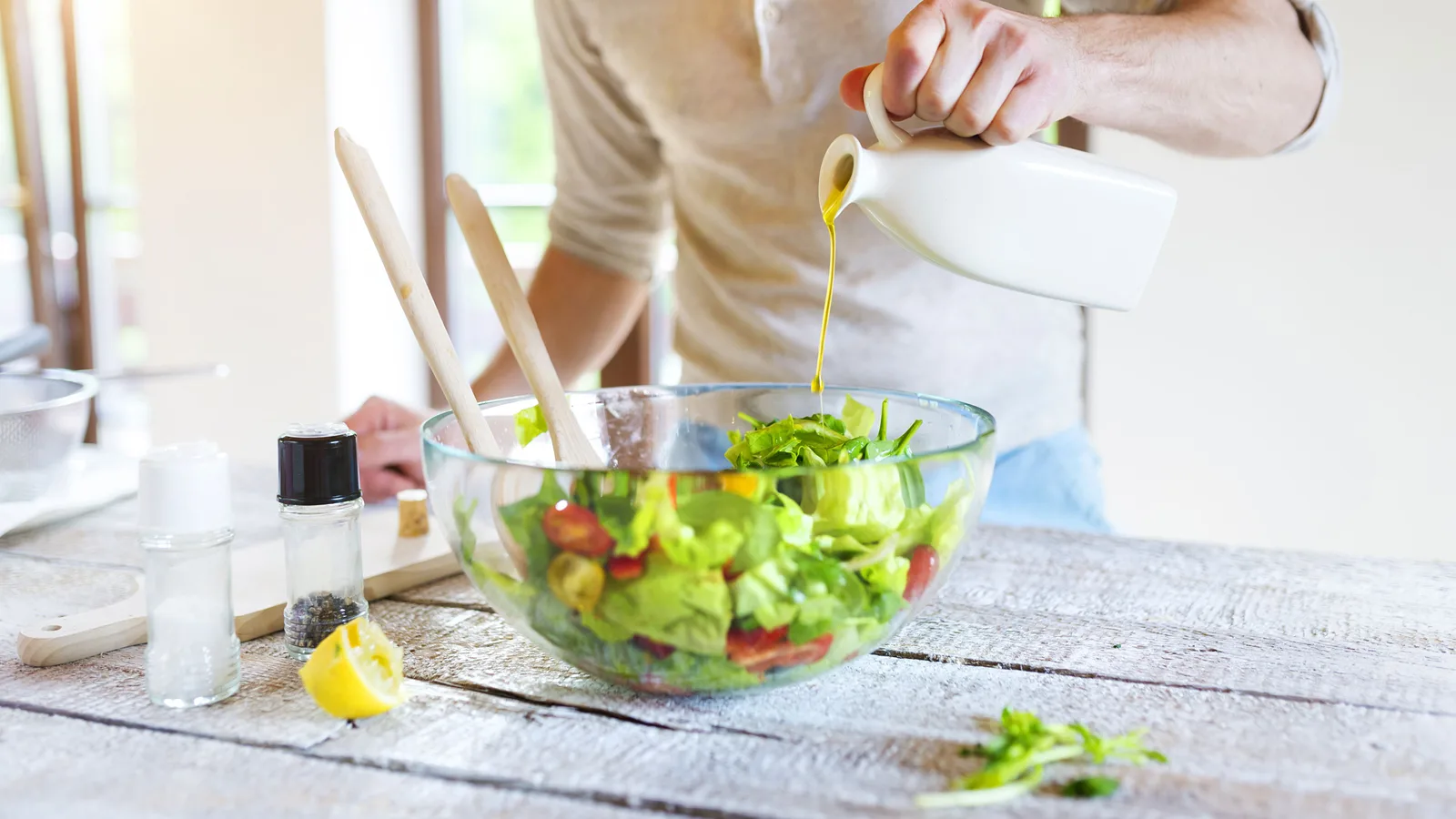
Measure 45 ml of oil. If you are whisking, pour it in a thin, steady stream while whisking constantly, so the dressing thickens and turns glossy rather than separating into pools of oil. If you are using a jar, add all the oil at once, seal it and shake hard for 20 seconds — the jar does the work for you.
-
03 /
Taste and adjust
Dip a piece of the leaf, vegetable or bread you are dressing into the vinaigrette rather than tasting it from the spoon — the dressing should taste right against the food, not on its own. Too sharp? Whisk in another teaspoon of oil. Too flat? A few drops more vinegar, or a pinch more salt. Too harsh? A small pinch of sugar or a little honey rounds it off.
-
04 /
Dress the food at the last moment
Toss the dressing through dry leaves or vegetables just before serving, using less than you think — around a tablespoon per portion is a good starting point. Any dressing left in the bowl can be served alongside. If you are making it ahead, keep it in the sealed jar and shake again before use.
Matching the ratio to the vinegar you use
Three to one is a starting point, not a rule. Vinegars vary in acidity and sweetness, so a dressing made with a sharp white wine vinegar needs more oil than one made with mellow balsamic. The table below gives sensible starting ratios to adjust from.
| Acid | Starting ratio (oil:acid) | Character | Good with |
|---|---|---|---|
| White wine vinegar | 3:1 | Crisp and clean, lightly sharp | Soft leaves, cucumber, fennel |
| Red wine vinegar | 3:1 | Fruity with a rounded bite | Tomatoes, robust mixed salads |
| Cider vinegar | 3:1 | Mellow and appley | Slaws, grated carrot, root vegetables |
| Sherry vinegar | 3:1 to 4:1 | Nutty and savoury | Roast vegetables, pulses, warm salads |
| Balsamic vinegar | 3:1, or sweeter to taste | Dark, sweet and syrupy | Tomatoes, mozzarella, bitter leaves |
| Lemon or lime juice | 4:1 | Bright and fresh, very sharp | Fish, herbs, green salads |
Choosing the oil
The oil is most of the dressing by volume, so it decides the flavour. Extra virgin olive oil brings fruitiness and a peppery finish, which suits tomatoes, pulses and robust leaves such as rocket. Cold-pressed rapeseed oil is milder with a gentle nuttiness and works with almost anything. Sunflower or other neutral oils let the vinegar and herbs do the talking, which is useful when you are dressing delicate leaves or adding lots of soft herbs.
A practical trick is to use mostly a mild oil with a spoonful of a strongly flavoured one for character. Whatever you use, taste the oil on its own first: if it tastes stale, bitter or like putty, it will taste that way in the dressing too.
Why vinaigrette splits, and how to bring it back
Oil and vinegar do not want to mix. Whisking breaks the oil into tiny droplets suspended in the vinegar, and that suspension holds for a while — but it is temporary. A dressing will always separate again if it stands, which is normal and not a fault. Shake or whisk it for a few seconds and it comes back together.
A dressing that splits while you are making it usually means the oil went in too fast, or there is far more oil than the vinegar can hold. Mustard, honey, a little yogurt or a spoonful of egg yolk slow the separation down because they help hold the droplets apart, which is why a mustard vinaigrette stays together longer than a plain one.
To rescue a split dressing, put a teaspoon of mustard (or a teaspoon of water) into a clean bowl and whisk the split dressing into it a drop at a time, then in a thin stream, exactly as if you were starting again. It will come back together.
Flavour variations worth trying
Once the ratio is second nature, the dressing becomes a template. Add one or two of these to the basic mix:
- Mustard — a teaspoon of smooth or wholegrain mustard adds tang and helps the emulsion hold.
- Honey or maple syrup — half a teaspoon takes the edge off a sharp vinegar and suits bitter leaves.
- Shallot or garlic — a very finely chopped shallot, left in the dressing for ten minutes, softens and sweetens; raw garlic is much more assertive, so use a quarter clove at most.
- Fresh herbs — chopped parsley, chives, tarragon or basil, stirred in just before serving so they stay green.
- Creamy — a spoonful of yogurt or crème fraîche turns it into a thicker dressing for slaws and potatoes; reduce the oil slightly.
- Toasted warmth — a pinch of toasted crushed seeds or crushed nuts, or a little smoked paprika, for dressings on warm vegetables.
Write nothing down; taste as you go and adjust the oil, acid and salt until it suits the dish in front of you.
Seasoning and tasting properly
Salt is the difference between a dressing that tastes of vinegar and one that tastes finished. Add it to the vinegar at the start so it dissolves, then taste again at the end, because the perception of saltiness changes once the oil is in.
Taste the dressing with the food it is for. A vinaigrette that seems too sharp off a spoon is often exactly right on bitter leaves, and one that tastes balanced alone can disappear on bland ingredients such as potato or white beans. Season the food lightly with salt as well — dressing cannot make up for under-seasoned leaves.
Storing vinaigrette and using up leftovers
- In the fridge
- In a sealed jar for about a week
- Before serving
- Stand at room temperature for 10–15 minutes, then shake
- If it sets solid
- Chilled olive oil can firm up; stand the jar in warm water for a minute
- With fresh garlic or shallot
- Use within 2–3 days; the flavour strengthens and sharpens
- With soft herbs
- Stir them in at serving time; they darken in the fridge
- Beyond salads
- Toss through warm potatoes, beans, roast vegetables or cooked grains
Vinaigrette is at its best in the first day or two, but it keeps well enough to be worth making a jar at a time. Label it if you make several, and always use a clean spoon or shake from the sealed jar rather than dipping anything wet into it.
Common mistakes and how to fix them
- Dressing the leaves too early. Wet leaves and early dressing both wilt a salad. Dry leaves thoroughly — a salad spinner or a clean tea towel — and dress at the table. Dry leaves also hold the dressing instead of letting it slide to the bottom of the bowl.
- Too much vinegar. Sharpness builds as the dressing sits on the food. Start slightly under and add more at the table.
- Under-salting. Fix with a pinch of salt dissolved in a few drops of water, not dry salt, which will not dissolve in the oil.
- A bitter or overpowering olive oil. Blend it with a milder oil or keep the strong oil for dipping.
- A dressing that tastes thin. A teaspoon of mustard, a little honey or a spoonful of yogurt gives it body.
- Making far too much. A little goes a long way; 60 ml of dressing is plenty for a salad for two to three people, and leftovers lose their freshness after a week.
Vinaigrette questions
Can I make a vinaigrette without mustard?
Yes. Mustard helps the dressing stay emulsified for longer, but it is not essential. Shake or whisk well just before serving, and expect it to separate again as it stands — that is normal.
How much vinaigrette should I use for a salad?
Allow roughly a tablespoon (15 ml) per portion of leaves and toss lightly, adding more only if the salad looks dry. Heavier ingredients such as potato or pulses take a little more, as they absorb dressing.
Can I dress hot food with vinaigrette?
Yes, and warm ingredients absorb dressing more readily, which is useful for potatoes, beans and roast vegetables. Toss them while warm rather than piping hot, so the dressing does not split or turn the leaves greasy.
Why does my vinaigrette taste bitter?
Usually the oil. Peppery extra virgin olive oil can taste bitter against sharp vinegar, and oil that is old or stale turns unpleasant. Try a milder oil, or use part strong olive oil and part neutral oil.
Does vinaigrette need to be kept in the fridge?
It keeps fresher and safer in the fridge, particularly if you have added fresh garlic, shallot or herbs. Take it out ten to fifteen minutes before serving, shake well, and use within a week.
What can I use instead of vinegar?
Lemon or lime juice is the most common swap and works with the same ratio, though you may want slightly more oil. A little verjus or a splash of dry white wine also works if you want acidity without vinegar's sharpness.